
Dune: The Battle for Arrakis Gameplay
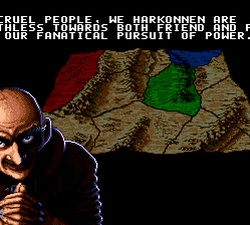
You sit down with Dune: The Battle for Arrakis — the one your friends simply called “Dune II on the Genesis” — and the spice sets the beat from the first screen. The Harvester lumbers over the dunes, the Carryall circles high, waiting to snatch the chubby workhorse and ferry it to the Refinery. Every run is a tiny duel with sand and fate: can you scoop one more load before the worm shows its maw? This Sega real-time strategy lives on flow: the base hums, the radar flickers to life on the minimap, danger rustles beyond the fog of war, and you catch the groove like a surfer riding a dune’s crest.
Rhythm of the sand
The game doesn’t squeeze you with a timer, it demands presence. On rock there’s order and foundation: lay concrete slabs, level a pad for a Wind Trap, Barracks, Refinery, and Silos. On the sand there’s wild freedom and risk: reach a rich spice field first and you’ll snowball faster, but one greedy dash and a sandworm crunches your Harvester like a crouton. That constant seesaw between greed and caution makes every mission feel fresh. You feel your appetite grow: one more pad, one more Silo, just a little more spice… and then you catch yourself — perimeter turrets are bare, power is in the red, and an enemy Ornithopter is sharpening its wings somewhere in the fog.
Three houses — three personalities
Atreides fight “clean”: Sonic Tanks roll sound across the dunes, Ornithopters lance the sky, and from the Palace you can call Fremen — the desert’s whisper turning into a sudden punch straight at the enemy’s heart. Harkonnen hit blunt and final: Devastators as rolling fortresses, and that Palace “gift” leaves a scorched trail in the sand. Ordos play on your nerves: the Deviator hisses toxin and flips enemy armor, while a Saboteur slips between towers — and there’s a flash where neat rows of buildings stood a minute ago. Switch House and your handwriting of victory changes, but it still feels unmistakably like Dune II.
Economy at your fingertips
The main melody here is logistics. A Carryall scoops the Harvester, the Refinery clacks its hatches, credits start flowing — and you decide where to inject them: another Wind Trap so you don’t brown out; a Starport where the price lottery might let you snag a Siege Tank early; a Repair Facility to patch up battered veterans. But without cover it’s all for nothing. Drop Gun Turrets, add Rocket Turrets, carve “pockets” between walls and rock where Quads and Trikes grind up raids. And always remember the enemy is stockpiling too — somewhere out there, beyond the fog of war, their base is breathing in sync with yours.
Raids, ambushes, and sieges
Combat unfolds like quick inhales and long exhales. Inhale — a lightning Quad raid on enemy Harvesters: a few clean bursts, their income tanks, and a Carryall hovers over an empty scoop. Exhale — a patient cliff-top siege: Siege Tanks methodically chew concrete, rocket batteries watch the horizon, your engineers extend slabs toward the base’s heart. All under constant enemy “probes”: little teams trying to pop a Silo or knock out your Radar. Catching the rhythm means pre-setting fields of fire, rolling up a repair crew, and intercepting a flank while your Ornithopters take the sky.
Cursor on the dunes
A gamepad sounds like a handicap, but in practice it’s choreography. The cursor skims the dunes, one button is orders, another calls a context menu, and you’re already tagging a strike group, tracing a path along the rocks, then hopping back to base — check power, lay concrete, order a couple of steel beauties at the Starport before prices spike. There’s no sense of pause: the world thrums, breathes, and you bounce between front and rear like a conductor keeping the drumline with one hand and snuffing a brass fire with the other. It’s not about fancy terms so much as traction — when your plan, turrets, routes, and bankroll lock into one clean line of attack.
Fine points
The sandworm isn’t just a boogeyman; it’s a mechanic that punishes greed and rewards awareness. Moving a column over sand? Break your route, hug the rocks, screen your Harvester with armor, keep a Carryall ready for an emergency lift. Radar on? Don’t tunnel-vision it: the map shows noise, but real danger often hides in silence. The Palace takes ages to prime its “big button,” but that click can decide a match: Atreides Fremen turn a raid into an avalanche; a Harkonnen strike slams morale into the dirt; an Ordos Saboteur snaps the backbone of infrastructure with one precise blast. And yes, that cold metallic voice in your ear when someone doesn’t come back — that’s this game’s pulse too.
In the best way, Dune II teaches you not to build “the ultimate base,” but to play the terrain, the spice, and the clock. Rock is your shield and your snare. Sand is speed — and risk. Spice is currency that evaporates without enough Silos. And the House you pick for the campaign is the style you commit to. When Siege Tanks breathe in unison, a Devastator drones, a Deviator hisses green, and Ornithopters pin needles where the concrete has already cracked, you remember why we still call it Dune: The Battle for Arrakis — or, simply, Dune II — and why we keep coming back for that hot sand underfoot and the sweet, heady smell of spice on the wind.